
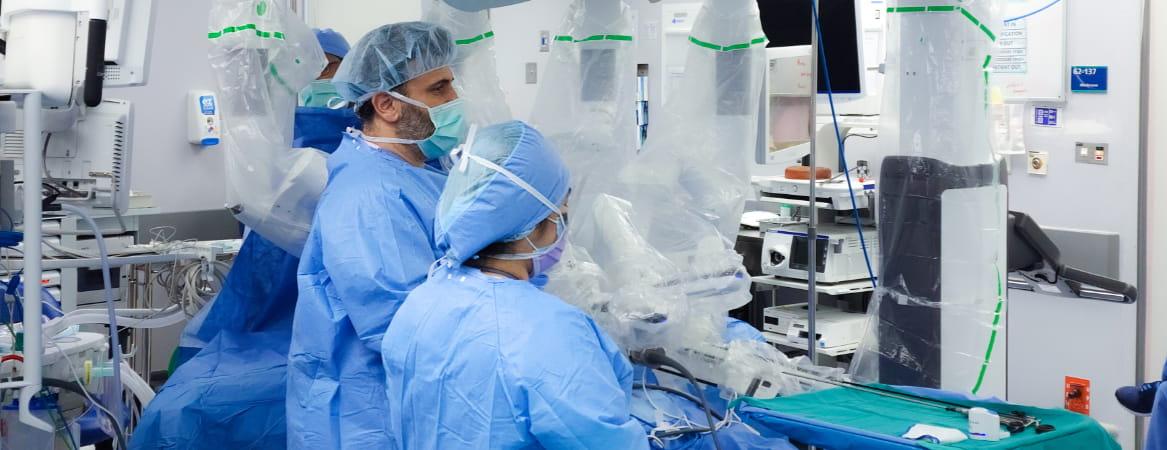
Robotic Surgery Gives New Lease of Life to Ulcerative Colitis Sufferer
November 26, 2025
JHAH surgeon conducts first robotic colorectal procedure of its kind in Saudi Arabia to treat patient suffering from debilitating inflammatory bowel condition.
Ahmed Khatiri was miserable. For as long as he could remember, he had suffered from an inflammatory bowel disease known as ulcerative colitis that caused frequent diarrhea, severe pain, occasional bleeding, and weight loss.
“Mentally, I was always on the edge of being angry,” Ahmed, 26, says. “I would explode at the smallest thing. I couldn’t focus on living my life or on doing my job to the best of my ability.”
Ahmed’s condition meant he needed to visit the bathroom at least 15 times a day, usually more — and with each attack came intense pain.
“If I ever went out anywhere, like a cafe, I’d have to think: ‘Is there a bathroom?’ Because if there wasn’t, I couldn’t go.
If I was at the gym and had to go to the bathroom during a session, I’d lose concentration, which made me frustrated. And if there was pain too, I might not be able to continue. That would make me angry.
Ahmed was prescribed the maximum permissible dose of steroids to help alleviate his condition, but he was still suffering, nonetheless.
“Most patients with ulcerative colitis respond to medication but unfortunately, Ahmed is in the minority who don’t,” Dr. Rizwan Ahmad, a consultant laparoscopic and robotic colorectal surgeon at Johns Hopkins Aramco Healthcare (JHAH), explains. “He was really very unwell; it was clear that his condition was handicapping him.”
After his medication stopped working, Ahmed met Dr. Rizwan in February 2024 to decide upon the best course of action. “I was afraid of having a colostomy bag,” Ahmed says. “I didn’t want that. I was only 25 at the time and I couldn’t imagine spending the rest of my life with a bag.”
Instead, Dr. Rizwan suggested removing Ahmed’s colon and fashioning a new one from his small intestine. The procedure, known as a restorative total proctocolectomy with ileoanal J pouch reservoir creation, means that a patient does not need a colostomy bag.
The procedure had previously been conducted in Saudi Arabia using laparoscopy, or keyhole surgery. However, Dr. Rizwan suggested that the procedure should, for the first time in the Kingdom*, be conducted with the assistance of a surgical robot — in this case, JHAH’s state-of-the-art da Vinci Xi robot.
“Very few centers in the Gulf region offer this operation, and patients typically fly to the USA or Europe for surgery,” Dr. Rizwan explains.
Ahmed agreed and underwent surgery in April 2024. It was a success.
“For the first few weeks after surgery, there were definitely challenges,” Ahmed says. “I wasn’t completely happy, but I was certainly more comfortable compared to before surgery. But after a few months, I got used to my new body. That was when I became much calmer. In fact, my family was shocked that I was not getting angry anymore!
Today, I’m very happy. I don’t have to worry about planning for bathroom trips because my frequency is down to about four times a day.
Ahmed said he would recommend the same surgery to anybody suffering as he did “because it improved my quality of life so much.”
Dr. Rizwan says: “Ahmed did brilliantly after his surgery. He now has near-normal bowel function and importantly, he no longer uses steroid medication. He messaged me four weeks after surgery wanting to know how much he could lift in the gym! We’re glad to see how strongly he has recovered and we wish him all the very best for the future.”
Learn more about colorectal surgery at JHAH
* The surgery was confirmed as a first of its kind in Saudi Arabia by Gulf Medical, the exclusive supplier of the da Vinci robot to hospitals in the Middle East.