
“At JHAH, I Felt Truly Heard”: Robotic Surgery Team Ends Amy’s 20-Year Struggle with Diverticulitis
November 05, 2026
After two decades of escalating symptoms that she blamed on herself, a JHAH team listened, revealed the hidden cause with a robotic operation – and gave Amy her life back.
When Amy, a 52-year-old American living in Saudi Arabia, was first hospitalized with diverticulitis at the age of 31 – years before moving to the Kingdom – she began a journey that would shape the next two decades of her life. The condition – in which small pouches form in the wall of the colon and can become inflamed or infected – brought waves of pain, bloating, and food intolerances that appeared and vanished without warning. Hers was what specialists call recalcitrant diverticulitis: disease that keeps returning no matter how carefully it is managed.
“Foods I could eat yesterday, I couldn’t eat today. I was mapping everything, restricting more and more, and I still couldn’t understand why my body was reacting all the time,” she recalled. “For years, I thought it was my fault that I was feeling so bad – that I was obviously doing something wrong.”
The turning point came when a close friend, aged just 40, was diagnosed with advanced colon cancer. Amy’s concern reflected a documented global trend: American Cancer Society research shows early-onset colorectal cancer rising in more than half of the 50 countries studied, with the sharpest increases among adults aged 20 to 49 – a disease, in the Society’s words, that can no longer be called an old person’s one. Deciding she could no longer put off finding answers, Amy booked a physical with her JHAH primary care physician, who referred her to the hospital’s Internal Medicine and Gastroenterology Consultant, Dr. Mohammed AlAwamy.
In keeping with the integrated way that JHAH’s specialists work, the gastroenterology team did not just wait for test results to run their course. They brought Dr. Rizwan Ahmad – a Fellow of the American Society of Colon and Rectal Surgeons and one of Saudi Arabia’s only US fellowship-trained colorectal surgeons – into the conversation from the start. This meant that when decisions needed to be made, no time would be lost bringing a surgeon up to speed.
“The moment I sat down with Dr. Rizwan, I felt I was actually being heard,” Amy said. “He listened, he took my experience seriously, and he never let us get sidetracked.”
That attentiveness shaped her care plan. Because her symptoms came and went, trying to obtain imaging while she was not feeling ill would reveal little. So, the team advised her to come to the Emergency Department when symptoms flared, allowing them to capture the clearest possible picture of her condition. When severe pain struck, the imaging confirmed what Dr. Ahmad suspected: a diseased section of colon that required surgery, alongside a significant infection that required hospital admission.
Performed robotically at JHAH, the operation revealed even more than the scans had shown. Amy underwent a robotic adhesiolysis and anterior resection – the removal of the diseased section of her colon and upper rectum – during which Dr. Ahmad also released extensive internal scar tissue before rejoining the healthy ends of the colon. That scar tissue, the legacy of major abdominal surgery Amy had undergone 15 years earlier, had anchored her colon deep in her pelvis and forced it into a hairpin turn – a hidden explanation for years of symptoms that no diet or lifestyle change could ever have resolved.
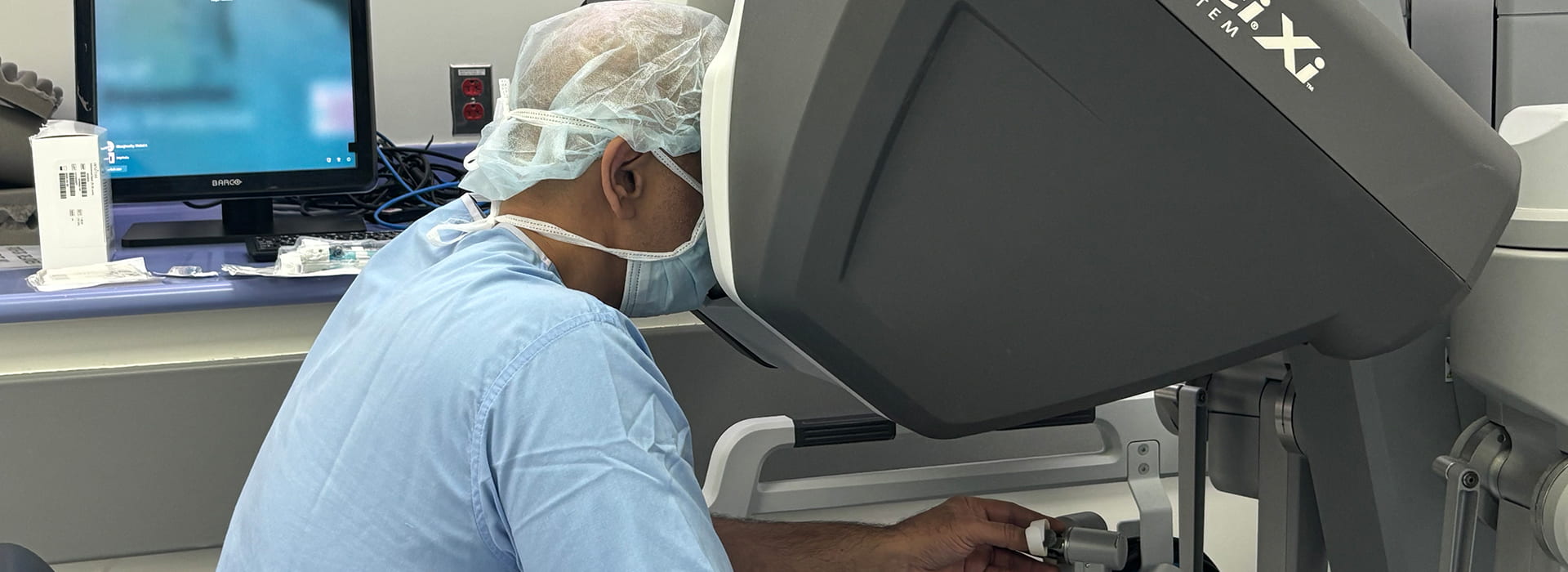
The robotic approach was chosen because operating in an abdomen shaped by earlier major surgery meant working through dense scar tissue in tight, deep spaces. These are precisely the conditions in which the robotic system’s magnified, high-definition view and fine instrument control matter most.
“Amy’s anatomy made this a complex operation,” said Dr. Ahmad. “The robotic platform gave us the precision to free the colon safely from the surrounding structures – a level of control that is very difficult to achieve with conventional techniques.” Dr. Ahmad founded JHAH’s robotic colorectal program in conjunction with Johns Hopkins University in 2023 and has performed some 200 robotic colorectal resections and more than 1,000 laparoscopic procedures at JHAH alone, after practicing in the United States.
“When he told me what he had found, it was the most validating conversation of my life,” Amy said. “It wasn’t my fault. It was never my fault. There was a physical reason I felt the way I did – and now it’s fixed.”
Amy’s recovery has gone just as planned: a four-day surgical stay, a return to light activities within six weeks and, by week eight, a normal routine again. “I feel like a million bucks,” she said. “I didn’t realize how much I was suffering, because it built up so gradually. Every small thing I can do again, I’m grateful for – I’m at eight weeks now, and I can’t remember when I felt so good.”
Her message to others living with unexplained or dismissed symptoms is simple: keep pushing until you are heard. “Advocate for yourself – and if that’s hard, bring someone with you who can help you tell the whole story,” she said. “Find a doctor who is truly on your team. They’re out there, and they can change your life for the better.”
People experiencing persistent digestive symptoms – or who want to understand their colorectal health and screening options – are welcome to contact JHAH to learn more. Current JHAH patients can speak with their care team or request an appointment directly through MyChart.